DSpace Repository
Palaeomorphology and environmental evolution of the Sado incised valley, SW Portugal
JavaScript is disabled for your browser. Some features of this site may not work without it.
| dc.contributor.author | Costa, A. M.
|
pt_BR |
| dc.contributor.author | Freitas, M. C.
|
pt_BR |
| dc.contributor.author | Mota, R.
|
pt_BR |
| dc.contributor.author | Leira, M.
|
pt_BR |
| dc.contributor.author | Arias, P.
|
pt_BR |
| dc.date.accessioned | 2022-12-26T12:17:38Z | pt_BR |
| dc.date.accessioned | 2023-02-28T11:13:50Z | |
| dc.date.available | 2022-12-26T12:17:38Z | pt_BR |
| dc.date.available | 2023-02-28T11:13:50Z | |
| dc.date.issued | 2022-09-12 | pt_BR |
| dc.identifier.uri | https://repositorio.lnec.pt/jspui/handle/123456789/1015665 | |
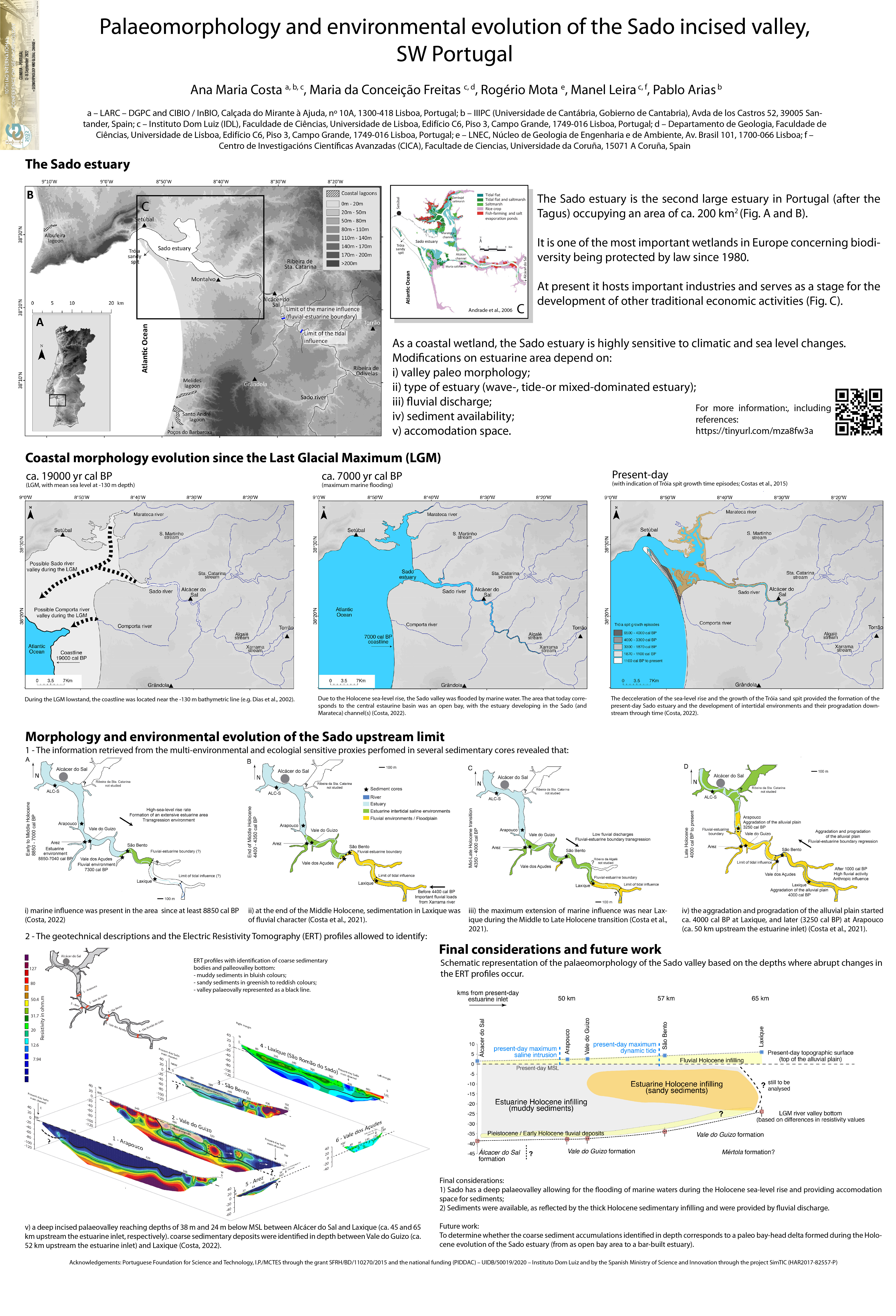
| dc.description.abstract | The infilling of coastal incised river valleys is an important sedimentary record that holds imprinting’s of depositional environments and sea-level variations. Notwithstanding, the stratigraphic record is difficult to interpret once: i) incised valley coastal areas preserve information both from marine and fluvial processes; ii) the morphology of the valley can derive from a simple incision cycle (e.g. LGM) or be the result of multiple incisions during pre-LGM Quaternary lowstands; iii) the stratigraphic sequence depends on the type of estuary, wave-, tide-or mixeddominated estuary; iv) palaeomorphology; v) fluvial discharge; and vi) sediment availability. To bypass these issues, several proposals have been published to help in the interpretation of incised valley stratigraphic successions and the identification of estuarine deposits preserved in depth. The Sado estuary is the second large estuary in Portugal (after the Tagus estuary) occupying an area of ca. 200 km2 combining both the external and internal domains. It is one of the most important wetlands in Europe concerning biodiversity being protected by law since 1980. At present it hosts important industries and serves as a stage for the development of other traditional economic activities. As a coastal wetland, the Sado estuary is highly sensitive to climatic and sea level changes. Notwithstanding the Sado valley morphology, its morphological and environmental evolution and the fluvial and estuarine responses to sea level changes are still poorly understood. The present study aims to characterise the palaeomorphology, morphological and estuarine evolution and sedimentary infilling in the upper areas of the estuarine zone located in the Sado (Alcácer do Sal) channel by combining information retrieved from sedimentary cores, geotechnical descriptions and Electric Resistivity Tomography (ERT) profiles. Geotechnical and ERT information reveal a deep incised palaeovalley reaching depths of 38 m and 24 m below MSL between Alcácer do Sal and Laxique (ca. 45 and 65 km upstream the estuarine inlet, respectively). The ERT data points to the occurrence of coarse sedimentary deposits in depth between Vale do Guizo (ca. 52 km upstream the estuarine inlet) and Laxique. Environmental and ecological proxies analised in the sediments retrieved from the Sado channel and tributaries reflect marine influence in the area (ca. 52 km upstream the estuarine inlet) since at least 8850 cal BP. The maximum extension of marine influence was detected in Laxique during the Middle to Late Holocene transition. Brackish conditions at this upstream location may have occurred earlier, but the coarseness of the sediment infilling prevented its recovery using coring devices and, consequently, its palaeoenvironmental characterization. Marine influence prevailed until 4000 cal BP at Laxique, from when the aggradation and progradation of the alluvial plain started. The aggradation of the alluvial plain began later (3250 cal BP) at Arapouco (ca. 50 km upstream the estuarine inlet). | pt_BR |
| dc.language.iso | eng | pt_BR |
| dc.publisher | 10th International Conference on Geomorphology | pt_BR |
| dc.relation | FCT - UID/GEO/50019/2019 | pt_BR |
| dc.relation | Estado Espanhol - SimTIC (HAR2017-82557-P) | pt_BR |
| dc.rights | openAccess | pt_BR |
| dc.subject | Resistividade elétrica | pt_BR |
| dc.subject | Paleomorphologia | pt_BR |
| dc.title | Palaeomorphology and environmental evolution of the Sado incised valley, SW Portugal | pt_BR |
| dc.type | conferenceObject | pt_BR |
| dc.description.pages | 1p | pt_BR |
| dc.identifier.local | Coimbra | pt_BR |
| dc.description.sector | DG/NGEA | pt_BR |
| dc.identifier.conftitle | 10th International Conference on Geomorphology | pt_BR |
| dc.contributor.peer-reviewed | NAO | pt_BR |
| dc.contributor.academicresearchers | SIM | pt_BR |
| dc.contributor.arquivo | SIM | pt_BR |