DSpace Repository
The prediction of floods in Venice: methods, models and uncertainty
JavaScript is disabled for your browser. Some features of this site may not work without it.
| dc.contributor.author | Umgiesser, G.
|
pt_BR |
| dc.contributor.author | Bajo, M.
|
pt_BR |
| dc.contributor.author | Ferrarin, C.
|
pt_BR |
| dc.contributor.author | Cucco, A.
|
pt_BR |
| dc.contributor.author | Lionello, P.
|
pt_BR |
| dc.contributor.author | Zanchettin, D.
|
pt_BR |
| dc.contributor.author | Papa, A.
|
pt_BR |
| dc.contributor.author | Tosoni, A.
|
pt_BR |
| dc.contributor.author | Ferla, M.
|
pt_BR |
| dc.contributor.author | Coraci, E.
|
pt_BR |
| dc.contributor.author | Morucci, S.
|
pt_BR |
| dc.contributor.author | Crosato, F.
|
pt_BR |
| dc.contributor.author | Bonometto, A.
|
pt_BR |
| dc.contributor.author | Valentini, A.
|
pt_BR |
| dc.contributor.author | Orlic, M.
|
pt_BR |
| dc.contributor.author | Haigh, I.
|
pt_BR |
| dc.contributor.author | Nielsen, J.
|
pt_BR |
| dc.contributor.author | Bertin, X.
|
pt_BR |
| dc.contributor.author | Fortunato, A. B.
|
pt_BR |
| dc.contributor.author | Gómez, B.
|
pt_BR |
| dc.contributor.author | Fanjul, E.
|
pt_BR |
| dc.contributor.author | Paradis, D.
|
pt_BR |
| dc.contributor.author | Jourdan, D.
|
pt_BR |
| dc.contributor.author | Pasquet, A.
|
pt_BR |
| dc.contributor.author | Mourre, B.
|
pt_BR |
| dc.contributor.author | Tintoré, J.
|
pt_BR |
| dc.contributor.author | Nicholls, R.
|
pt_BR |
| dc.date.accessioned | 2021-10-01T16:21:47Z | pt_BR |
| dc.date.accessioned | 2021-12-02T14:58:50Z | |
| dc.date.available | 2021-10-01T16:21:47Z | pt_BR |
| dc.date.available | 2021-12-02T14:58:50Z | |
| dc.date.issued | 2021-09 | pt_BR |
| dc.identifier.citation | DOI: 10.5194/nhess-21-2679-2021 | pt_BR |
| dc.identifier.uri | https://repositorio.lnec.pt/jspui/handle/123456789/1014053 | |
| dc.description.abstract | This paper reviews the state-of-the-art in storm surge forecasting and its particular application in the northern Adriatic Sea. The city of Venice relies crucially on a good flood forecasting system in order to protect the extensive cultural heritage, their population, and their economic activities. Storm surge forecasting systems are in place to warn the population of imminent flood threats. In the future, it will be of paramount importance to increase the reliability of these forecasting systems, especially with the new MOSE mobile barriers that will be completed by 2021, and will depend on accurate storm 35 surge forecasting to control their operation. In this paper, the physics behind the flooding of Venice is discussed, and the state of the art of European storm surge forecasting is reviewed. The challenges that lie ahead for Venice and its forecasting systems are analyzed, especially in view of uncertainty. Some extreme events that happened in the past and were particularly difficult to forecast are also described | pt_BR |
| dc.language.iso | eng | pt_BR |
| dc.publisher | Copernicus Publications | pt_BR |
| dc.rights | openAccess | pt_BR |
| dc.title | The prediction of floods in Venice: methods, models and uncertainty | pt_BR |
| dc.type | article | pt_BR |
| dc.description.pages | 2679-2704pp | pt_BR |
| dc.description.volume | Volume 21 | pt_BR |
| dc.description.sector | DHA/NEC | pt_BR |
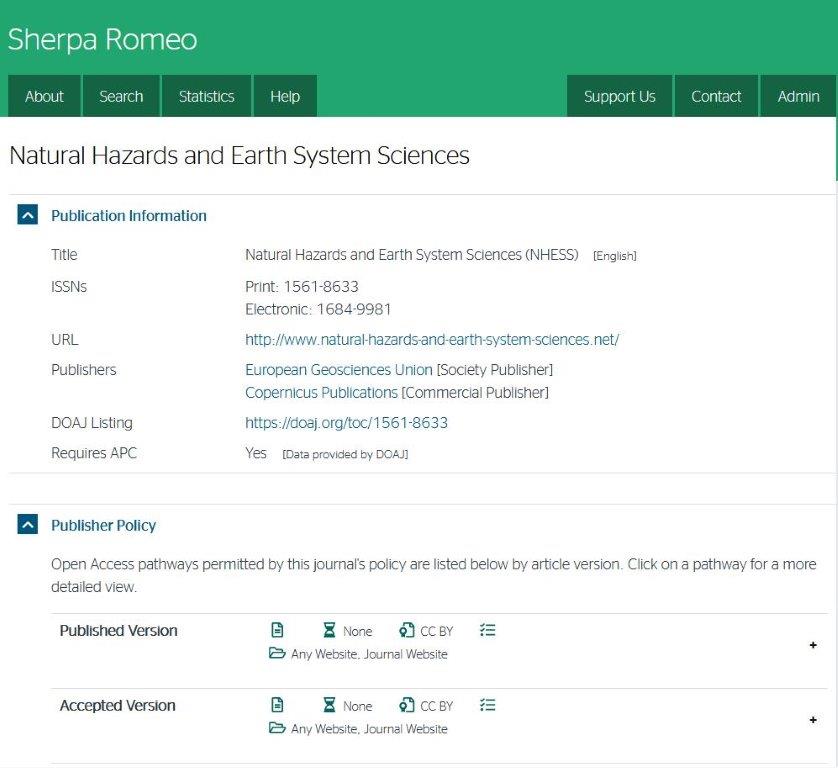
| dc.description.magazine | Natural Hazards and Earth System Sciences | pt_BR |
| dc.contributor.peer-reviewed | SIM | pt_BR |
| dc.contributor.academicresearchers | NAO | pt_BR |
| dc.contributor.arquivo | SIM | pt_BR |